Thursday, May 23, 2013

Honey, We Meet Again

Honey at Sunset
When a bicycle leaves you at a loss for words, is that a good thing? With hundreds of miles now on this Honey Cyclocross demo bike, I am leaning toward yes. Because I'm not exactly itching to give it back.

Last summer I was briefly without a suitable bike for dirt and gravel. When a local unpaved ride came around, a buddy lent me her Honey Cyclocross racing bike. I wrote about that bike here, then rode the Kearsarge Klassic on it successfully. And that should have been that. But months later, even as I happily rode my own bike, memories of that CX Honey kept intruding. In my first impressions write-up I described how "different" its handling felt from anything I'd tried before. As a wannabe bicycle designer, this gnawed at me. What was it about that bike? 

Diverged Start
Enter geographical luck of the draw. Honey Bikes are local to me, the project of Rob Vandermark whom I know through the Ride Studio Cafe bicycle shop and Seven Cycles. Last Fall, we had occasion to talk about the cyclocross bike I'd tried, and I struggled to articulate why I found its handling so "different." 

At this time, a batch of Honey demo bikes was being prepared for the Ride Studio Cafe, and one of them was set up for me. The idea was a long-term test ride and review: I would ride the bike until it became familiar, allowing me to articulate what I found so striking about its handling. In particular, we discussed how appropriate a bike like it might be for long unpaved rides, and how it compared to the 650B low trail model I was comfortable with.

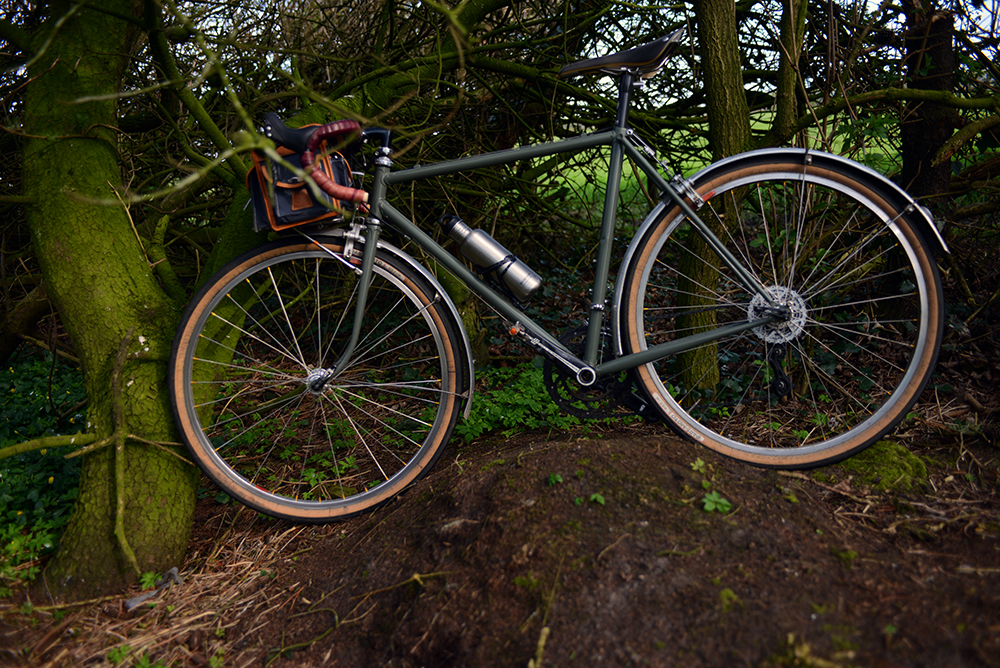
Honey Cyclocross, Winter Lilac
The bike arrived just as a series of snow storms hit the Northeast, which made for some appropriate pictures of the "winter lilac" colour.

I should note here that the bicycle reviewed here is completely stock in everything from size and geometry to component group and finish. Honey bikes are not custom, but made-to-order stock bikes, available in a variety of sizes and option packages. This production method allows them to keep prices in the $2,400-4,000 range for complete bikes, and to offer quick turn-around. The bicycles are steel, with carbon fiber forks (though steel forks are also available). Models include road, utility, mixed terrain, mountain, cyclocross and more. All frames are handmade in the USA, the current series produced by Seven Cycles in Watertown, MA.

Honey Cyclocross, Winter Lilac
Honey bikes are offered in two types of finishes. The standard finishes are tone-on-tone, and so subtle that the logos and other markings are virtually invisible unless you stand inches from the bike or intentionally bump up the contrast in pictures to draw them out. For those who prefer a finish with visible logos, Honey also makes "team" finishes, where the panels and lettering contrast the main colour.

Honey Cyclocross, Winter Lilac
Like the bike I had borrowed last summer, this is a stock 52.5cm Honey Cyclocross race frame (they also have a utility cross model, but this is not it). The sizing figures on Honey bikes refer to the virtual top tube length. Because this bike was set up for me from the get-go, it fit me much better than the one I rode previously. The handlebar height and width, the stem length, and the saddle position were configured with my fit in mind. The brakes were routed right=front, the way I set up my own. When I got on the bike, everything immediately felt natural, and there is a lot to be said for this. With roadbike test rides, fit really matters. 

Honey Cyclocross, Winter Lilac
The Honey was set up with a SRAM Rival group and TRP mini-v brakes. The brakes work excellently (more on that here), which was a great relief from previous experiences with cantis. And while I have a Campagnolo setup on my own bikes, I am also comfortable with SRAM levers and have no problem switching back and forth between the two systems. 

Honey Cyclocross, Winter Lilac
As I see it, going with SRAM on a bicycle like this has several benefits. The main one, is that SRAM now makes it possible to use low gears with a road drivetrain and modern integrated shifters. Their new wifli system, despite the silly name, is extremely useful in that it allows for a 12-32t cassette. Paired with a 50/34t crankset, that almost gives you a 1:1 low gear, without having to do anything unconventional to the drivetrain. Unofficially, I am told that the wifli derailleur will also handle a 34t cog from a mountain or touring cassette, but I wanted to ride the bike with everything stock before trying out-of-spec configurations. As is, the SRAM Rival drivetrain has been functioning flawlessly ...which brings me to the other benefit - the value. While I love the feel of Campagnolo Chorus, I've been disappointed with their lower-end groups in the past couple of years. At the lower to mid range, I have to admit that SRAM groups feel nicer. In particular, I find Rival to be the sweet spot as far as cost to performance ratio.  

Honey Cyclocross, Winter Lilac
The bike is fitted with Mavic Ksyrium Elite wheels and Continental Cyclocross Speed tires, 700Cx35mm. The tires were chosen for their versatility: The tread can handle most unpaved terrain, without slowing the bike down too much on pavement. I have found this useful. Off pavement, I feel comfortable with these tires on dirt, gravel, reasonably shallow sand and not-too-thick mud. On pavement, I do find them slower than slick road tires, but it's not too bad and I don't mind working a little harder on paved sections. These tires are also great in the rain and light snow. In bad weather, I find myself reaching for this bike.

Speaking of snow... Though I did not ride a lot over this past winter, the little riding I did was mostly on the Honey. Partly this was due to the tires: They handled unexpected patches of ice and snow on the road better than the tires on my own bikes. But partly it was also the handling. I will get more into this later, but when I got the demo Honey, fitted to my riding position, my first impression was that it felt like a toy - I was compelled to try stuff on it that I had not done on other bikes - like jumping over things and riding in snow. So I did, until eventually I crashed into a tree riding in the woods. My leg and hip were covered in bruises that took weeks to heal, but luckily the bike was fine!

Honey at Sunset
Spring took a long time arriving this year. But finally by mid-March I started putting in some proper miles. As a way of ensuring I get used to the Honey's handling, for some time I rode it exclusively: Group rides, solo rides, paved rides, dirt rides, short rides, long rides - for 3 weeks straight it was all Honey, all the time. After that, I began riding my own bikes again (skinny tire road and fat tire dirt), alternating between the Honey and them.

For some time, I marveled at the handling every time I got on this bicycle. I am going to use experiential terms here. One term that comes to mind is "hyper hip-steerable." Maybe even "rear wheel drive." That is, the bike struck me as overly sensitive to movement at the hips, to the point that it almost felt like the front end was controlled from the back. For instance, let's say I was behind a rider and wanted to pass them. On this bike, I discovered a maneuver, where I could flick my hips ever so slightly while accelerating and "slingshot" past the rider in front of me in a tight, perfectly controlled arc. Maybe that sounds crazy, or maybe this is something everyone but me has been doing all along, I can never tell. In any case, it's easy and intuitive to do on this bike. 

But unless I intentionally fling it sideways, the bike has a "tracks straight" feel to it at all speeds. Even when walking it I can feel this: Using the gentlest touch, I can easily  steer it by the back of the saddle and the front won't turn or flop to the side. Riding it at excruciatingly slow speeds is easy as well; it really "wants to stay upright" and go straight.  

Honey at Sunset
Hopping over bumps, rocks and roots is unusually easy. The first time it happened, I simply saw a huge root in front of me, and before I knew it my front wheel was sailing over it and landing on the other side. I was not conscious of having pulled up on the handlebars. I can now hop over objects on other bikes too, but it takes more effort.

On descents, initially I found that I could not easily turn and maneuver this bike using the same approach as on others I've ridden. But I quickly learned that changing my balance over the saddle made it controllable in these situations. I still do not understand this part entirely, but my subjective feel is that I almost hang off the bike to the side in order to steer it on turns. Possibly, this is my way of compensating for not being able to lean the bike itself sufficiently. 

All the characteristics described become less noticeable the more I ride the bike. But if I go even as much as a week without riding it, I immediately notice them again when switching from my own bicycles. It's not a matter of better or worse, but just a "Hey, this is different!" kind of feeling every time.

Honey at Sunset
The aesthetics of the Honey Cyclocross bike are modern and sporty: thick tubes, unabashedly sloping top tube, straight fork. This look is growing on me - or maybe a more accurate way to put it would be "I appreciate it for what it is." I do love the winter lilac finish. The welds are very smooth, more or less invisible under the paint. And the overall look has a unity and harmony to it that makes sense to me visually. 

The tubing is oversized and thin-walled. Pinging it with my fingernail, there is a distinct hollow ring. Riding the bike, it feels extremely stiff - though not in a disagreeable way. It feels light in motion, fast to accelerate, ever-ready and ever-awake. Despite the stiffness, the ride is not harsh. The jury is still out on the relationship between flex and responsiveness to pedaling effort, and I won't attempt to make any connection here. I will only say that I enjoy how stiff this bike feels.

I intentionally did not look at the geometry in advance, so as not to bias my impressions. When I did have a look later, I did not see anything too unusual. Longer chainstays and less bottom bracket drop than typical with road geometry; slightly higher trail. None of it seemed sufficiently dramatic to explain my strong reaction to the bike. Maybe it's one of those "the whole is greater than the sum of its parts" things. There is, after all, a lot I don't understand about bicycle design.

Honey at Sunset
The one word I would use to describe the Honey Cyclocross bike is "fun." As in exciting, playful, toy-like. This bike really moves, and under a more skillful rider than me I am sure it would move even better. While I am obviously not evaluating it in that context, I can see how a bike like this would make a good choice for racing cyclocross. 

As far as unpaved brevets and such, I think the CX Honey could work nicely for those who want a lightweight, modern, racy bike with wide 700C tires. Although designed for short races, to me it feels great over 100K distances. The main thing, is that after hours in the saddle I find it delightfully non-fatiguing.

Not being a utility bike; this particular Honey model is not built for racks or carrying heavy loads. Riding it with a full, wide Carradice-style saddlebag in the rear, I can feel the weight (or drag - not sure which). With a smaller bag that tucks under the saddle (like the Dill Pickle shown here) this is considerably less pronounced. I have not tried a bag on the front - though I've now been lent an Ortlieb system to experiment with, and will report back.

Honey at Sunset
Riding this bike on dirt and gravel, I am as fast as I'm capable of being, and reasonably confident riding over most types of terrain I encounter. On pavement, I am slower on the Honey than on my skinny-tire roadbike. And compared to my low trail 650Bx42mm all-steel bike, the Honey is on average about the same both on pavement and dirt. One aspect where they differ, is if I try to seriously push the speed beyond my comfort zone - for instance, in order to keep up with faster riders. When doing this, I can push both bikes pretty hard, but on the Honey I feel less tired afterward. The 5lb difference in the weight of the bikes could account for this, as could the difference in frame and fork materials. On the other hand, when all is said and done I prefer my own bike's front-end handling. It is simply more intuitive to me, and on challenging terrain with twists and turns I am generally more relaxed and precise on it for that reason. Nonetheless, I appreciate the Honey's handling as well. I especially enjoy switching between the bikes and experiencing the difference, adapting to one then another.  

It fascinates me to no end how two bikes can excel at the same task, yet ride and feel so differently. I will elaborate on this shortly, but recently I began working with Rob Vandermark on a special project. My experience with the CX Honey - in conjunction with my own bike - has been particularly educational in that context.

With unpaved riding increasingly popular, it's exciting to have choices for go-fast bikes with fat tires. The Honey Cyclocross bike is certainly worth considering - fast, fun, made in Massachusetts, and reasonably priced with lots of sizing options. It's been a pleasure getting to know this bicycle, improving my handling skills and expanding my horizons in the process. 

Tuesday, May 21, 2013

Covering Distance

Last week I did two 100 mile rides several days apart. The first I rode on my own bike, with my camera, stopping along the way. That was really nice. The second I did on an unfamiliar demo bike, riding the course straight through except for a lunch stop. That was really nice too. The rides didn't take all day and they didn't wipe me out, allowing me to work before and after. Had time been no object, I felt as if I could have kept going.

To me, it is this private moment of realisation that "I have it in me" to do this kind of distance, casually - that feels like an accomplishment. More so than, say, an official brevet finish. It is not that I don't value organised events and their objective measures of performance. It's more that when doing an event, I already know that I can do it; I would not attempt it otherwise with all the logistics involved. In that sense, it feels not unlike taking a test based on material I've already learned. It's the learning itself that's thrilling. That "A-ha!" moment. Doing well on the test? It's nice, and often necessary. But it's not the same as the learning itself.

Maybe this line of thinking just means that I am hopelessly non-competitive. Or maybe it is simply not a good analogy. In fact almost certainly not. But there's a grain of something in it, somewhere.

Covering new distance, covering new material. And along the way that feeling of having truly grasped, understood, internalised something new - something that had previously seemed unattainable.

Monday, May 20, 2013

Paul Carson Step-Through Bicycle

Paul Carson Step-Through
As I stood composing this shot, a woman passing by with grocery bags stopped beside me. Looking at the bicycle, she tilted her head to the side and smiled. "That bike!" she said, "It looks like... happiness." It was a funny outburst, no doubt inspired more by the sunny day and the quaint tree-lined street, than by the bicycle itself. But I knew what she meant. Because this particular bike fit into the idyllic backdrop perfectly. Simple, friendly and inviting, it looked like no more and no less than what it was - a yellow bicycle on a beautiful summer morning. Maybe Paul is onto something here, I thought.

Paul Carson, Artisan's Asylum
Even though Paul Carson makes bikes and teaches others how to, I do not really think of him as a framebuilder. He is more of an engineer, an experimenter, a problem-solver. Paul doesn't see what he does as a craft, but as production that he loves to simplify and optimise. You might not find him polishing frame joints for hours on end. But you will find him making ridable prototypes with speed and ingenuity ...as well as the tools, fixtures and parts to facilitate doing so. In a sense, Paul is like a magic genie who can turn wishful thinking into reality, and fast. On one occasion, I watched him make a rear rack in under 20 minutes, so that he could try out a pannier on his roadbike. Another time, I wondered how difficult it would be to make a double-plated fork crown from scratch. He asked me to elaborate. I explained and showed pictures. He thought about it, then ducked into a corner. Hack-hack-hack. File-file-file. Flames! Flames! "Like this?" 

Paul Carson Step-Through
And there it was - double-plated fork crown for oval blades, spaced for a wide tire, just as I described. "Glad you like it," he shrugged. "I'll get a batch of these machined." That's Paul Carson, in a nutshell.

Paul Carson Step-Through
Unlike most other local builders, Paul is not part of the racing scene. He isn't even really part of the local bike scene so much; he is just his own entity. Perhaps that is why he gravitates toward making city bikes. City bikes have an immediate and obvious utility. And it is fun to see them cruising around the neighbourhood, ridden by ordinary people, carrying milk and potted plants. Over the past months, we've been discussing some ideas for step-through designs. We both like the feel of old English 3-speeds and we also like low trail. Wouldn't it be great to combine these? While our ideas diverge when it comes to wheel size and exact geometry specs, overall Paul's idea of a great step-through is not dissimilar to mine. When he asked me to try his prototype, I was eager to give it a go. 

Paul Carson Step-Through
Made of touring grade cro-moly tubing, the Paul Carson Step-Through is designed around 700C wheels with up to 35mm tires and fenders. It has a gently curved top tube, and is proportioned so that the handlebars can sit at or just above saddle height. 72° head tube angle and 73° seat tube angle. Trail in the mid-40s.

These framesets will be made to order in a range of sizes and with a menu of options, with prices starting at $650 for a TIG-welded frameset with standard (lugged) fork crown, made for caliper brakes. The price includes powdercoat in a range of standard colours and a headset. Extras include the option of fillet-brazed construction, handmade double-plated fork crown, handmade stem, and cantilever/ v-brake bosses. Turn around is 4 weeks.

Paul Carson Step-Through
Paul designed this frame with versatility of build in mind. Semi-horizontal dropouts make it possible to use either derailleur or hub gearing. The bottom bracket height (300mm with 28mm tires) is sufficient to set up the bike as a fixed gear. Braze-ons include eyelets for racks and fenders. 440mm chainstays are long enough to carry panniers without heel strike. And the front-end geometry will handle a front load.

Paul Carson Step-Through
The demo bike I tried was built in size 55cm and with all the extra options. Fillet-brazed joints, smoothly finished, but not fussed over. 

Paul Carson Step-Through
Canti-lever bosses and cable hanger. Twin plate fork crown.

Paul Carson Step-Through
And fillet-brazed stem (threadless).

Paul Carson Step-Through
Paul set this bike up with 28mm tires and fenders, a single speed drivetrain,

Paul Carson Step-Through
swept-back handlebars with cork grips,

Paul Carson Step-Through
and a Brooks Flyer saddle.

Paul Carson Step-Through
Leaving my own bike at the Asylum, I rode the Step-Through around town in the course of the morning, simulating some of my regular routes. When I struggle for something to say about a bike's handling, that generally strikes me as a good thing - as it means nothing is "wrong" with it. Paul's bike felt familiar, natural, normal. It also felt casual and accessible, more like a cool, repainted vintage bike than a new handmade bike. And it really did look oddly at home in our neighbourhood.

The fit worked well for me, with a more aggressive posture than a fully upright bike. There was no toe overlap with the size 55cm frame and 28mm tires with fenders, though it was close. The steering felt responsive and intuitive. My own city bikes are low trail (under 30mm) and this bike handled like a more neutral version of them.

Paul Carson Step-Through
As far as nit-picks, the step-over height could be a bit lower for my taste. And in my view, a practical city bike (especially for a pothole-ridden neighbourhood like ours) would ideally be specced with 35mm wide tires minimum, not maximum. This is where a smaller wheel size might be worth considering, especially if toe clearance is a priority. Personally, I also prefer lower bottom brackets. But I know that some riders like to feel as if they are "sitting high in traffic" on their bike, which the higher bottom bracket accomplishes. Otherwise, not much else to criticise; I liked the bike.

Paul Carson Step-Through
Paul Carson is an exciting person to know. He has ideas about streamlining the framebuilding process to make handmade bikes more accessible, and I will be following his work with interest. Made in this vein, the Carson Step-Through is not meant to be an artisanal show-stopper. It is a cute, friendly, ridable bike, with a friendly price, handmade in Somerville MA. 

Saturday, May 18, 2013

Speaking of Saddles

Saddle Fit at Cycle Loft
Earlier this week I was visiting Cycle Loft - a local bicycle shop known, among other things, for its extensive fit studio. I will be test riding a few of their bikes this summer, and the staff suggested I undergo a fitting session beforehand. As we were getting started, the fitter - Joel - caught sight of the Selle Anatomica I was riding. He asked whether I wanted to use my own saddle, given how particular it was, or try something new.

Today there are lots of high quality, well thought-out saddle designs on the market, in a variety of materials. The trick is to find one that fits our particular anatomy, position and riding style. For the past two years I've been going back and forth between a Berthoud touring saddle and a Selle Anatomica on my roadbikes. These saddles are as close as I've been able to get to being truly comfortable over long distances. But neither is perfect. So I decided to keep an open mind and see what the fitter recommended.

Saddle Fit at Cycle Loft
To start with, Joel measured my sit bones. This is something I've never had done "professionally" before, so it was pretty exciting. Cycle Loft uses the Specialized "Body Fit" method, which, as I understand it, is comparatively un-intrusive (no pelvic fondling, etc.). But there is a nifty device involved. A stool was brought out with a butt-shaped pillow, upon which I sat as instructed. When I stood up, my sit bones left two clear indentations, which Joel swiftly measured.

Saddle Fit at Cycle Loft
The figure was 135mm - considerably narrower than what I thought my sit bone width was based on my DIY measurements (the figure I'd come up with was more like 150mm). But we repeated the process just to make sure and got the same number again - so looks like 135mm it is.

Joel explained that a saddle should be wider than the sit bone width itself. How much wider depends partly on the rider's position and partly on the saddle's shape. As far as the rider's position, the more leaned forward you are, the narrower area of support is needed. That much I'd known. As far as saddle shape, Joel showed me a selection or road/racing saddles and pointed out that on some the sitting surface was flat across, while on others it was rounded, like an arc. For all my careful scrutiny of saddle shapes, this was not a distinction I'd explicitly been aware of before, so I was excited to learn something new. For any given rider, on a rounded saddle the width needs to be greater than on a flat saddle.

According to the fit chart, the saddle width recommended for my sit bones was 155mm minimum. My Berthoud saddle (which is flat) measures 160mm across, and my Selle Anatomica (which is rounded) measures 170mm across. My comfort with both makes sense according to this fit method.

Saddle Fit at Cycle Loft
Next, Joel asked what I liked and disliked about the saddles I normally use. I explained that my saddles are fairly wide across the rear, yet have narrow, racing-style noses. The wide rear and narrow nose combination works for me, because this way my butt feels fully supported but I don't get thigh-rub. Other saddles I've tried tend to be either too narrow or too wide all around, which doesn't work. I also like the feel of suspended leather, compared to other surfaces I've tried.

As far as what I don't like, that is a little trickier to explain. The Berthoud feels a bit too hard, whereas the Selle Anatomica has a bit too much give. And with each, I occasionally - at random times, it seems - feel pressure or pinching in the middle of my "soft tissue." It happens rarely now compared to the problems I used to have, but it does still happen occasionally. We discussed all this in detail, as well as the other saddles I've tried. I described my dislike of gel (I sink into it and feel horrible pressure), my inability to ride Terry saddles (the slots are somehow in the wrong place), and finding the edges of many racing saddles "too sharp" as I pedal.

Saddle Fit at Cycle Loft
After taking all of this in, Joel suggested I try the Romin Evo saddle by Specialized (interesting write-up about it here). It had everything I seemed to need: a rounded wide rear (168mm across), a narrow nose, and a firm, but not rock-hard, surface. A channel down the middle and a curved nose were designed to avoid contact with exactly the pressure-prone spots I'd identified. It is not a woman-specific saddle, but then neither are my own. A synthetic saddle made by a big-name manufacturer, it was not what I would normally gravitate toward, but I'd said I would be open minded, and so I would.

The Romin Evo is now fitted on the demo bike I'm riding. I could not feel it under me on the initial 30 mile ride, but I will withhold judgment until after the follow-up, 100K ride.

But whether this particular saddle wins me over is beside the point. What I appreciated the most was the generally informative conversation with the fitter - who I felt was neutral and knowledgeable when it came to various styles, materials, aesthetics and brands of saddles. I would like to keep learning myself, and at some point to post a comprehensive guide that might be of help to those at a loss for where to start.

Friday, May 17, 2013

Breaking Away

Fruitlands, Harvard MA
A luckless morning. I had attempted to join a 100K club ride, only to get an important phone call as I pulled up to the start. By the time I got done the others were nearly an hour ahead. I would never catch up. I decided to ride the route anyway. 

The weather had been beautiful. But as I set off, it began to rain - cold, hard little drops, carried sideways by the wind, sharp against my face. 

On the road there was more traffic than usual. A mile in, a driver cut me off and I barely avoided a collision. Still fuming over this, I began to notice that my throat hurt. I was hot and cold. I felt sluggish. Maybe I was running a fever. Maybe I should count my losses.

A deep irritation over a day wasted was building up. Workdays that have no clear end or beginning. A weak constitution that has derailed my plans one time too many. If it's not one thing, it's another. 

Nagog Hill Farm
For some miles, it was angry riding. Riding a wave of frustration. But I pedaled. Mechanical motions. Round and round. Rain and chills, traffic, scratchy throat, round and round. "Oh shut up," my legs said to my throat. We would break away. 

I had the sense that once I was a certain number of miles out, it would all resolve itself, because turning back would no longer make sense. Concord, West Concord, Maynard. I pedaled harder.

But then came a moment of doubt. I had not meant to be on my own with my thoughts on this day. What would I do out there, for hours, with all these thoughts? "Oh shut up" my legs said to my brain. 

And we broke away. 

Steele Farm, Boxborough MA
20 miles in. As if someone had waved a magic wand, the cars were gone. The sun came out. The pedals lost their resistance. We floated up hills. My mind emptied. 

In Still River I passed a Benedictine monastery. It stands on top of a hill, overlooking a green and blue rolling landscape. Slowly I rode through it, not seeing a single person on its grounds. The monks must have been indoors.

In Boxborough I stopped at a farm. It had visitor hours and notices posted, but looked abandoned. With my bike, I stood in the middle of a field dotted with white barns, thinking of nothing. I heard ringing in the air. The field was full of dandelions. 

Fruitlands, Harvard MA
The climb leading up to the Fruitlands was shorter and tamer than I remembered. Today, the hill was an invisible host, gently taking me by the arm and leading me to the view. 

At the hilltop, I had the place to myself. No cars were parked at the scenic overview along the side of the road. No cyclists passed. I had made it all alone up there and the world felt far, far away. The sun flickered through thick clouds, a flood of light going on and off. I looked down at the little mountain clusters across the state line. The entire world felt close.

Harvard General Store
Descending into town, I remembered that I had not eaten for hours and stopped at the general store. When I ordered coffee and a sandwich, it felt strange to talk - as if I hadn't spoken out loud in years. Was I even saying the right words? The boy behind the counter had an inscrutably friendly face that had seen many cyclists. 

Nagog Hill Farm
Orchards and orchards on the return leg. The apple orchards have such neat rows of such crooked, erratic-looking trees. Line-dancing trees. Shaker trees.

This ride was coming to an end much too fast, I thought. I wasn't ready. And I veered off course onto another road, with more uphill floating, more orchards.

But at length, unfamiliar farms gave way to familiar ones, a gentle reminder of being homeward bound. Then finally, the bikepath, and the city - with 100 miles on the computer and frustration a faint memory. 

Sometimes if you just keep pedaling, everything else breaks away, falls away. If you keep pedaling, the mind quiets down.